
For years, ERP systems were treated as operational software. Something businesses implemented to manage finance, procurement, inventory, HR, or supply chain activities. AI, on the other hand, was viewed as a separate innovation layer focused on analytics, automation, and prediction.
That separation no longer exists.
Today, in enterprise transformation discussions, one reality is becoming very clear: AI initiatives fail when enterprise data and business processes are fragmented. Most organizations are now realizing that AI is not the starting point of transformation. ERP is.
At JAAD Consulting, we’ve seen this shift happen firsthand across enterprises where we offered ERP implementation services. Businesses often approach AI with excitement — predictive analytics, automation, intelligent forecasting, AI copilots — but underneath, their operational landscape is still disconnected. Finance works on one system, procurement on another, reporting happens in spreadsheets, approvals move through emails, and leadership teams struggle to get reliable real-time visibility.
In those situations, AI does not solve the problem. It amplifies the chaos.
What actually enables AI to create measurable business impact is a strong ERP ecosystem that centralizes operational data, standardizes business processes, and creates visibility across the organization.
That is why ERP is no longer just enterprise software. It is becoming the operational backbone of AI-driven organizations.
AI Is Only as Intelligent as the Enterprise Data Behind It
One of the biggest misconceptions in the market right now is that AI can compensate for poor enterprise architecture.
It cannot.
Most organizations today are sitting on enormous volumes of business data, but very little of it is structured in a way AI systems can reliably use. We often see enterprises where procurement data does not align with finance records, inventory numbers differ across systems, reporting logic changes department by department, and operational approvals happen outside the ERP altogether.
Then leadership asks:
“Why are our analytics inconsistent?”
“Why are forecasts inaccurate?”
“Why are automation initiatives failing?”
The answer is usually not the AI model. The problem is the operational foundation underneath it.
ERP systems solve this by creating process consistency and centralized data governance across the enterprise. When implemented correctly, ERP becomes the single operational source of truth. Every transaction, inventory movement, supplier update, financial entry, procurement cycle, and operational workflow becomes connected inside one ecosystem.
That changes everything for AI.
AI systems thrive in environments where:
- Data is standardized
- Processes are structured
- Workflows are traceable
- Historical records are reliable
- Real-time visibility exists across departments
Without ERP maturity, AI initiatives become isolated experiments rather than scalable enterprise capabilities.
This is why organizations investing seriously in AI are simultaneously modernizing their ERP environments, especially through Oracle Fusion Cloud and cloud-native enterprise ecosystems.
Where AI and ERP Are Creating Real Enterprise Value
The conversation around AI often becomes too theoretical. In reality, businesses care about operational outcomes: reducing delays, improving forecasting, lowering costs, increasing visibility, and making faster decisions.
This is where ERP and AI together are creating measurable impact.
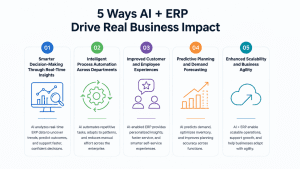
Predictive Operations Instead of Reactive Management
Traditional enterprises operate reactively.
Inventory shortages are discovered too late. Procurement delays impact production schedules. Financial risks become visible after reporting cycles are complete. Leadership teams spend weeks consolidating reports before strategic reviews.
AI integrated with ERP changes this operational model completely.
We are now seeing organizations use AI-driven ERP systems to predict demand fluctuations, identify supply chain risks, monitor procurement bottlenecks, and forecast operational disruptions before they escalate into business problems.
For example, in manufacturing environments, ERP-driven AI models can analyze procurement patterns, supplier performance, production timelines, and inventory movement together — helping businesses anticipate shortages weeks earlier than traditional reporting systems.
That level of operational intelligence is only possible when enterprise-wide data is connected through ERP.
AI Is Reducing Decision Latency Across Enterprises
One of the least discussed operational challenges in large organizations is decision latency.
Enterprises often do not suffer from lack of information. They suffer from delays in accessing reliable information.
Leadership teams wait for reports.
Departments reconcile conflicting numbers.
Finance validates operational data manually.
Supply chain teams work from outdated spreadsheets.
This slows down the entire organization.
Modern ERP ecosystems integrated with AI significantly reduce this friction. Decision-makers gain access to real-time operational visibility instead of static historical reporting.
This has a direct impact on:
- Procurement planning
- Cash flow forecasting
- Inventory optimization
- Production scheduling
- Vendor management
- Financial governance
In fast-moving industries, reducing decision latency becomes a major competitive advantage.
Intelligent Automation Is Reshaping Enterprise Workflows
Automation is not new. Enterprises have automated processes for years.
What is changing now is the intelligence behind the automation.
Traditional automation follows rules.
AI-driven ERP automation adapts dynamically based on patterns, exceptions, and operational behavior.
For example:
- Invoice approvals can now be prioritized based on payment risk
- Procurement workflows can identify unusual purchasing behavior
- ERP systems can flag operational anomalies before compliance issues arise
- Financial systems can detect patterns that indicate reconciliation risks
This moves enterprises away from repetitive process execution toward intelligent operational management.
However, none of this works effectively when business processes are fragmented outside the ERP environment.
ERP Is Becoming the Enterprise Control Tower
One of the most important changes happening right now is the evolution of ERP from a transactional system into an enterprise intelligence platform.
Historically, ERP systems recorded operational activity.
Now, they are actively guiding operational strategy.
Modern ERP platforms integrated with AI are becoming centralized control towers where organizations monitor performance, predict disruptions, optimize operations, and improve business agility in real time.
This is especially important for enterprises operating across multiple geographies, business units, suppliers, and operational layers.
The more complex the enterprise becomes, the more critical ERP visibility becomes for AI-driven decision-making.
Cloud ERP Is Accelerating AI Adoption
Many businesses still operate on legacy ERP environments that were never designed for AI-scale operations.
This is one of the biggest reasons enterprises are accelerating migration toward cloud ERP platforms like Oracle Fusion Cloud.
Cloud-native ERP ecosystems provide:
- Real-time scalability
- Centralized data architecture
- Faster integrations
- AI-ready infrastructure
- Continuous innovation cycles
- Improved security and governance
From our experience at JAAD Consulting, organizations moving toward cloud ERP are not simply modernizing technology. They are preparing their operational architecture for the next decade of intelligent business operations.
That distinction matters.
The Enterprises That Win with AI Will Build Strong ERP Foundations First
The market is currently flooded with AI conversations, but over the next few years, the gap between successful and unsuccessful AI adoption will become very visible.
The organizations that succeed will not necessarily be the ones investing the most in AI tools.
They will be the ones that invested early in operational discipline, connected enterprise architecture, and scalable ERP ecosystems.
AI cannot compensate for fragmented operations.
It cannot fix disconnected workflows.
It cannot create visibility where no operational structure exists.
What it can do is amplify the efficiency, intelligence, and agility of enterprises that already have strong operational foundations.
That is why ERP is becoming central to enterprise transformation strategies again — not as administrative software, but as the infrastructure layer powering intelligent business operations.
At JAAD Consulting, this is exactly where enterprise transformation conversations are headed. Businesses today are not simply looking for ERP implementation support. They are looking for scalable operational ecosystems that can support AI adoption, intelligent automation, advanced analytics, and long-term digital transformation.
With deep expertise in Oracle ERP, Oracle Fusion Cloud, enterprise integrations, and modernization strategies, JAAD Consulting helps organizations move beyond transactional systems and build future-ready enterprise environments designed for intelligent growth.
FAQs
Why is ERP critical for AI-driven organizations?
ERP systems centralize enterprise data and standardize business processes, creating the structured operational foundation AI systems need to generate accurate insights and automation.
Can AI initiatives fail because of poor ERP systems?
Yes. Many AI projects fail because enterprise data is fragmented, inconsistent, or disconnected across departments. Without strong ERP architecture, AI cannot scale effectively.
Why are businesses moving toward cloud ERP for AI adoption?
Cloud ERP platforms provide AI-ready infrastructure, real-time data visibility, scalability, better integrations, and continuous innovation capabilities that support modern intelligent operations.